

The BNPL impact on mortgage application Australia changed permanently on 10 June 2025 when Buy Now Pay Later products became regulated credit under the National Consumer Credit Protection Act. Every Afterpay, Zip Pay or similar account now appears as a credit commitment on your file – and lenders assess it as an ongoing liability that reduces your borrowing capacity. This guide explains exactly how BNPL affects your mortgage application in 2026, how much it reduces your borrowing power and what to do about it before you apply.
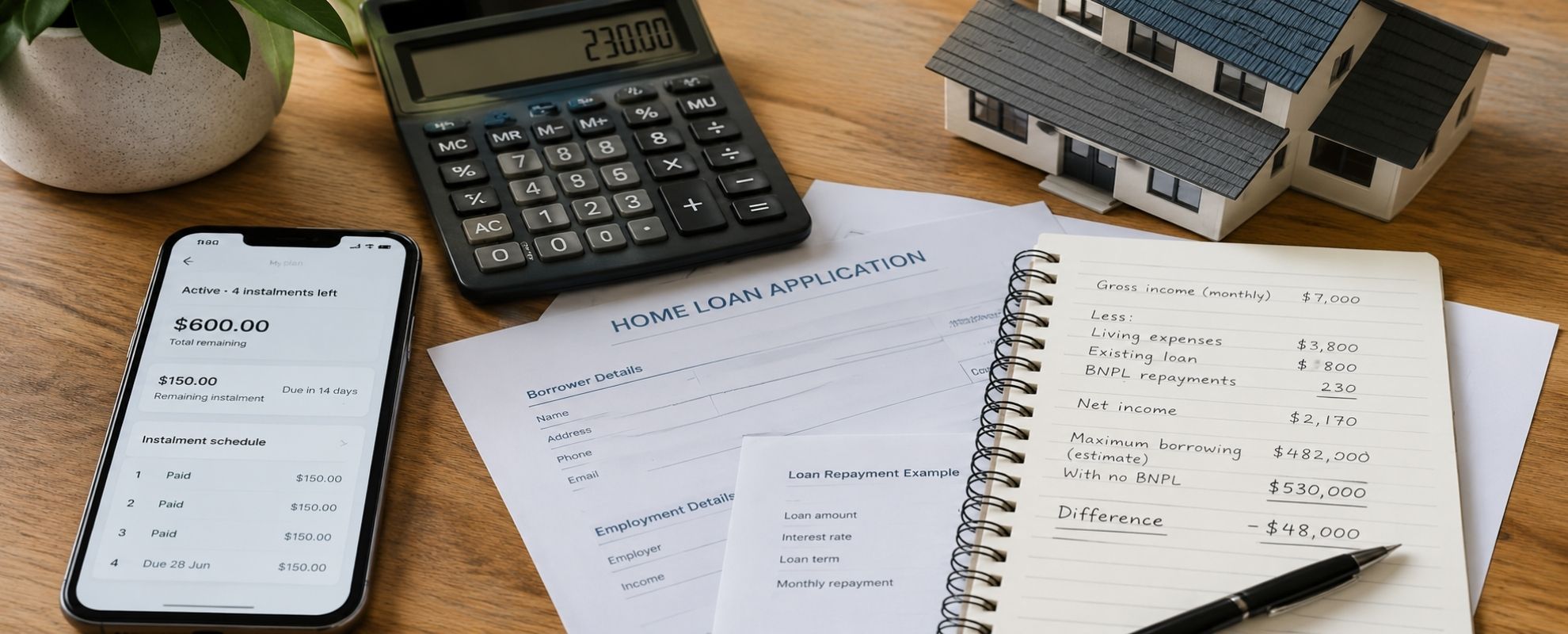
Does Afterpay reduce borrowing capacity? Yes – and the reduction is larger than most borrowers expect. Lenders assess BNPL commitments as an ongoing monthly liability regardless of whether you currently owe anything. The typical assessment treats the BNPL credit limit divided by 12 as a monthly commitment. A $2,000 Afterpay limit is assessed as approximately $167 per month in committed expenses.
The BNPL impact on mortgage application Australia is significant since regulation commenced on 10 June 2025. Each $2,000 BNPL limit reduces borrowing capacity by approximately $25,000 to $30,000. Closing all BNPL accounts before applying restores full borrowing power.
At the current APRA serviceability buffer, that $167 per month reduces your maximum borrowing capacity by approximately $25,000 to $30,000 depending on the lender. If you have multiple BNPL accounts – Afterpay, Zip Pay, Humm and a store credit account – the combined limits can reduce borrowing capacity by $80,000 to $120,000. This is the single most common reason first home buyers in Melbourne discover they can borrow less than expected during pre-approval.
Buy now pay later credit assessment lenders each apply slightly different policies when evaluating BNPL commitments. Since 10 June 2025, all BNPL providers must hold an Australian Credit Licence and conduct responsible lending assessments. Every new BNPL application creates a credit enquiry visible on your credit file for five years. Existing BNPL accounts appear as open credit commitments.
The major banks assess BNPL limits as ongoing liabilities in the serviceability calculation. Some lenders require all BNPL accounts to be closed and confirmed as closed on the credit file before they will approve the application. Others accept open BNPL accounts but include them as monthly commitments. Non-bank lenders tend to be more flexible – some exclude BNPL accounts with zero balances from the serviceability calculation. Clarity Financial Solutions identifies which lender policy best suits your situation and advises whether closing accounts before applying is necessary or optional.
Close BNPL accounts before applying for loan applications if you want to maximise your borrowing capacity. The process involves three steps. Step one: pay any outstanding balance to zero. Step two: contact the BNPL provider directly and request formal account closure – not just deleting the app. Step three: request written confirmation that the account is closed. This confirmation is required by most lenders as evidence that the liability no longer exists.
Clarity Financial Solutions recommends closing all BNPL accounts at least 30 days before submitting a mortgage application to allow the credit file to update and to present the cleanest possible financial position to the lender.
Zip Pay Afterpay lender serviceability rules determine how much each BNPL account costs you in borrowing capacity. The key variable is whether the lender assesses the credit limit or the outstanding balance. Most major banks assess the full credit limit divided by 12 as a monthly commitment. This means a $3,000 Zip Pay limit costs $250 per month in assessed liabilities – even if the current balance is zero.
A smaller number of lenders assess only the outstanding balance. If the balance is zero and the account remains open, the impact on serviceability may be minimal or zero. However, the open account still appears on the credit file and may trigger additional questions from the credit assessor. For borrowers with multiple BNPL accounts totalling $5,000 or more in combined limits, closing all accounts before applying can restore $75,000 to $150,000 in borrowing capacity depending on the lender and interest rate environment.


The BNPL impact on mortgage application Australia fundamentally changed when the Treasury Laws Amendment (Responsible Buy Now Pay Later and Other Measures) Act 2024 commenced on 10 June 2025. Before this date, BNPL accounts were largely invisible to mortgage lenders. After this date, every BNPL provider must hold an Australian Credit Licence, conduct responsible lending assessments and report to credit bureaus.
In 2026, the practical impact is that every active BNPL account appears on your comprehensive credit report alongside credit cards, personal loans and existing mortgages. Lenders see the account open date, credit limit, repayment history and any defaults. Multiple BNPL enquiries in a short period can also indicate financial stress to a credit assessor. Clarity Financial Solutions reviews your full credit file before submitting any application and advises on the optimal BNPL strategy for your specific lender and loan structure.
Yes. Since 10 June 2025, Afterpay is regulated credit that appears on your credit report. Lenders assess the Afterpay credit limit as a monthly liability, reducing your borrowing capacity by approximately $25,000 to $30,000 per $2,000 of limit. Closing Afterpay before applying removes this liability from the assessment.
In most cases, yes. Closing all BNPL accounts and obtaining written closure confirmation removes the assessed liability from your serviceability calculation and maximises borrowing capacity. Clarity Financial Solutions recommends closing accounts at least 30 days before applying to allow credit file updates.
No. Major banks generally assess the full BNPL credit limit as a monthly commitment. Some non-bank lenders assess only the outstanding balance or exclude zero-balance accounts. Clarity Financial Solutions matches you to the lender whose BNPL policy is most favourable for your situation.
Since June 2025, yes. BNPL accounts now report to credit bureaus under comprehensive credit reporting. On-time repayments contribute positively. Missed payments, defaults and multiple credit enquiries in short periods contribute negatively. The account's existence also increases your assessed liabilities for mortgage serviceability.
A single $2,000 BNPL account reduces capacity by approximately $25,000 to $30,000. Multiple accounts with combined limits of $5,000 or more can reduce capacity by $75,000 to $150,000. The exact impact depends on the lender's assessment policy and the current interest rate environment with the RBA cash rate at 4.35% as of August 2026.
Yes. We review your full credit file, identify all open BNPL accounts, calculate the borrowing capacity impact, and advise whether to close accounts before applying. This analysis is part of our free pre-application review across 40+ lenders.

This article was prepared by Preeti Sidhu, Mortgage Broker at Clarity Financial Solutions (ACL 475676). Information is general in nature and does not constitute financial advice. Always consult a licensed mortgage broker before making any financial decisions.

The BNPL impact on mortgage application Australia is measurable, significant and almost always avoidable. Closing BNPL accounts before applying is the simplest way to restore borrowing capacity – and Clarity Financial Solutions guides you through the process at no cost. Explore how debt consolidation can further strengthen your lending position.
WhatsApp us