

Cross collateralisation risks property investors face are among the most damaging structural mistakes in portfolio lending – yet most borrowers do not realise they have been cross-collateralised until they try to sell, refinance or access equity from one property independently. Cross-collateralisation means two or more properties are pledged as combined security for one or more loans under the same lender. This gives the lender a claim across your entire portfolio for every loan – restricting your flexibility, increasing your risk and complicating every future lending decision. This guide explains exactly what cross-collateralisation is, why it happens and how to avoid it in 2026.
Linking multiple properties under one lender is the most common path to cross-collateralisation. It typically happens when a borrower uses equity from property one to fund the deposit on property two through the same bank. The bank structures both properties as security for the combined debt – meaning each property backs every loan in the portfolio. This creates a single security pool rather than independent standalone loans.
Cross collateralisation risks property investors face include restricted ability to sell or refinance individual properties, forced portfolio reassessment by the lender, and complicated tax and estate planning. Standalone security for each property preserves maximum flexibility.
The lender benefits from cross-collateralisation because it holds more security against the total debt. The borrower loses flexibility. If you want to sell property one, the lender reassesses the remaining security against all outstanding loans – and may require you to pay down debt or provide additional security before releasing the property from the mortgage. This can delay or prevent a sale. The same restriction applies when refinancing one loan to a different lender or accessing equity from a single property.
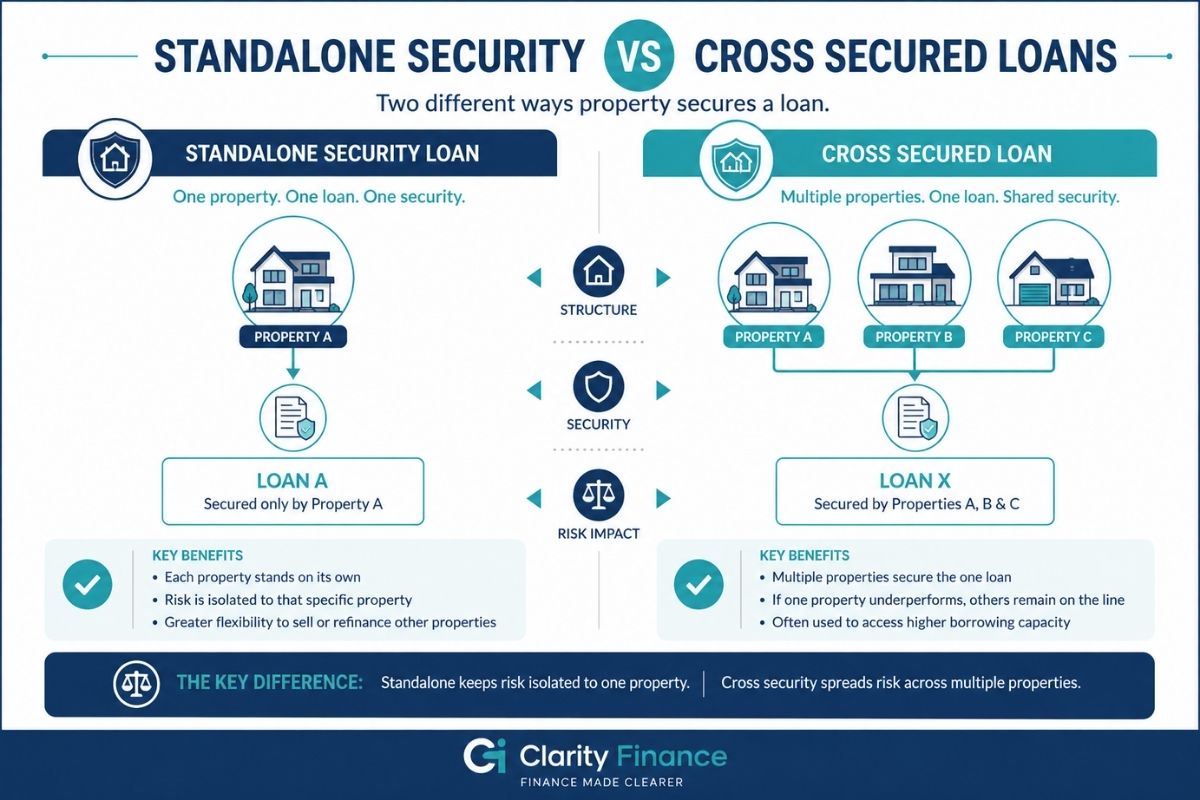
Standalone security vs cross secured loans is the fundamental structural choice in portfolio lending. Under standalone security, each property secures only its own loan. Property one backs loan one. Property two backs loan two. Each loan can be sold, refinanced at the right time, discharged or restructured independently without affecting the other. Under cross-secured lending, both properties back both loans. No single property can be released without the lender’s consent and reassessment of the entire portfolio.
Standalone security is the default recommendation from experienced brokers because it preserves maximum flexibility for future decisions. It allows you to move each property to the best-rate lender independently, sell one property without triggering a portfolio reassessment, access equity from one property without affecting the other, and manage each investment loan structure independently for tax purposes.
Why brokers recommend standalone securities comes down to protecting the borrower’s ability to make independent decisions about each property in the future. Cross collateralisation risks property investors face compound as the portfolio grows. With three or four cross-secured properties under one lender, selling one property requires the lender to revalue all remaining properties, recalculate total LVR across the portfolio, and potentially demand additional funds or security before releasing the sold property from the mortgage.
Unwinding a cross collateralised portfolio requires refinancing each property to a standalone security position. This involves obtaining current valuations for each property, calculating standalone LVR for each loan against its own security, and applying to one or more lenders for individual loans secured only against the relevant property. The process is essentially a multi-property refinance.
The costs of an unwinding cross collateralised portfolio process include discharge fees from the current lender, new establishment fees with the receiving lender or lenders, valuation fees for each property, and potentially LMI if any individual property’s standalone LVR exceeds 80%. These costs are typically justified by the long-term flexibility and risk reduction gained. Clarity Financial Solutions models the full unwinding cost against the ongoing risk of maintaining the cross-security structure to determine whether unwinding is cost-effective for your portfolio.

Clarity Financial Solutions structures every multi-property loan as standalone security from the outset. When you use equity from property one to fund the deposit on property two, we structure the equity release as a separate loan split on property one – and the purchase loan for property two is secured only against property two with a different lender or the same lender under a separate facility. This standalone approach ensures cross collateralisation risks property investors face are eliminated at the point of structuring – not after the damage is done.
For existing portfolios that are already cross-collateralised, we conduct a full portfolio review including current valuations, standalone LVR calculations and unwinding cost analysis across 40+ lenders. The goal is to move each property to the best-rate lender on standalone security with the lowest total transition cost. With the RBA cash rate at 4.35% in August 2026, securing the best rate on each individual property through annual rate reviews through standalone lending can deliver significant annual interest savings across the portfolio.

Cross-collateralisation occurs when two or more properties are pledged as combined security for one or more loans under the same lender. This means each property backs every loan in the portfolio - giving the lender a claim across all properties and restricting your ability to sell, refinance or access equity from any single property independently.
Check your loan documents or mortgage schedule. If multiple properties are listed as security for the same loan, or if your loans reference each other as additional security, your properties are cross-collateralised. Clarity Financial Solutions can review your current loan structure and confirm whether cross-security exists.
Yes. Unwinding a cross collateralised portfolio involves refinancing each property to a standalone security position with the same or a different lender. Each property must have a standalone LVR of 80% or below to avoid LMI. Clarity Financial Solutions models the costs and recommends the most efficient unwinding strategy across 40+ lenders.
Yes. When you sell a cross-collateralised property, the lender reassesses the remaining security against all outstanding loans. If the remaining portfolio does not meet the lender's LVR requirements, you may be required to pay down debt or provide additional security before the lender releases the sold property's mortgage. This can delay settlement.
In rare cases, cross-collateralisation can help a borrower access a larger total loan amount or avoid LMI on a new purchase. However, the long-term flexibility and risk costs almost always outweigh the short-term benefit. Clarity Financial Solutions structures standalone securities as the default for every multi-property client.
The equity is released as a separate loan split on the existing property - secured only against that property. The new purchase loan is secured only against the new property. Both loans are independent. This means you can sell, refinance or restructure either property without affecting the other. Clarity Financial Solutions arranges this structure as standard across all portfolio lending.

This article was prepared by Preeti Sidhu, Mortgage Broker at Clarity Financial Solutions (ACL 475676). Information is general in nature and does not constitute financial advice. Always consult a licensed mortgage broker before making any financial decisions.

Cross collateralisation risks property investors face are avoidable with the right loan structure from the outset – and fixable through a managed unwinding process for existing portfolios. Clarity Financial Solutions structures every multi-property loan on standalone security as standard. Learn more about our investment property mortgage broker Melbourne approach to portfolio lending.
WhatsApp us