

The rental income borrowing power calculation Australia determines how much of your existing or projected rental income a lender will count toward your ability to service a new loan. Most Australian lenders shade rental income by 20% to 30% — meaning they count only 70% to 80% of gross rent in their serviceability assessment. This shading accounts for vacancy periods, property management fees, maintenance and rate risk. The difference between a lender that shades at 70% and one that shades at 80% can represent $50,000 to $100,000 in approved borrowing capacity on the same application. This guide explains exactly how the calculation works and how to maximise the rental income counted toward your lending assessment in 2026.
How lenders assess existing rental yield starts with the gross weekly rent and applies a shading factor to arrive at the assessable rental income. If your Melbourne investment property generates $650 per week in gross rent ($33,800 annually), a lender applying 80% shading assesses your income from that property at $27,040. A lender applying 70% shading assesses the same property at $23,660 — a $3,380 difference that compounds through the serviceability calculation.
The rental income borrowing power calculation Australia uses shading of 20% to 30% — meaning lenders count only 70% to 80% of gross rent. Choosing a lender that shades at 80% instead of 70% can add $50,000 to $100,000 in borrowing capacity on the same application.
The shading percentage varies by lender. Major banks typically shade at 70% to 80%. Some non-bank lenders and specialist investment lenders shade at 80% to 90% — counting more of your rental income and materially increasing your borrowing power. The proof required for existing rental income is a current lease agreement or rental statement from your property manager (less than 90 days old). Clarity Financial Solutions selects the lender whose rental shading policy delivers the strongest serviceability result for your portfolio.
The 80% rental shading policy Australian banks apply means that for every $100 of gross rent your property earns, the bank counts only $80 toward your assessable income. The remaining $20 is discounted to account for vacancy (typically assumed at 2 to 4 weeks per year), property management fees (5% to 8% of gross rent), maintenance costs, council rates and water rates. This is a conservative assumption that protects the lender but reduces the borrower’s apparent income.
At the current APRA serviceability buffer of 3% above the actual loan rate, the impact of shading compounds. On a $500-per-week rental property with 80% shading, the assessable weekly income is $400. At 70% shading, it drops to $350 — reducing the net income available to service the new loan by $50 per week or $2,600 per year. Across a portfolio of three investment properties, the cumulative shading difference between a 70% and 80% lender can represent $7,800 to $10,000 per year in assessable income — translating to approximately $50,000 to $100,000 in additional borrowing capacity. The 80% rental shading policy Australian banks offer is therefore a significant selection criteria for portfolio investors.
The negative gearing effect on serviceability test varies significantly by lender. Negative gearing occurs when the cost of holding an investment property (interest, rates, insurance, management fees, depreciation) exceeds the rental income — creating a tax-deductible loss. Some lenders apply a negative gearing add-back to the serviceability calculation, recognising that the tax benefit effectively increases the borrower’s net income. Others ignore the negative gearing benefit entirely and assess income and expenses without tax adjustment.
Lenders that apply the negative gearing add-back increase your assessable income by the estimated tax benefit of the loss — typically 30% to 37% of the net rental loss depending on your marginal tax rate. This add-back can improve borrowing capacity by $20,000 to $40,000 per negatively geared property. Note that from 1 July 2027, the 2026-27 Budget reforms limit salary-offset negative gearing on established properties purchased after 7:30pm on 12 May 2026 — new builds remain exempt. Clarity Financial Solutions models the post-reform negative gearing effect on serviceability test for every investment application.
Adding rental receipts to lending application documentation strengthens the assessed rental income by demonstrating actual received income rather than relying solely on the lease agreement. Lenders accept two types of rental income evidence: a current lease agreement showing the agreed weekly rent, or a rental statement from your property manager showing actual rent received over the most recent three to six months. The rental statement is stronger because it shows consistent income actually received.
Clarity Financial Solutions reviews your rental income documentation before submitting to ensure the maximum assessable rental income is counted. The rental income borrowing power calculation Australia is only as strong as the evidence you provide — and the lender you apply with.

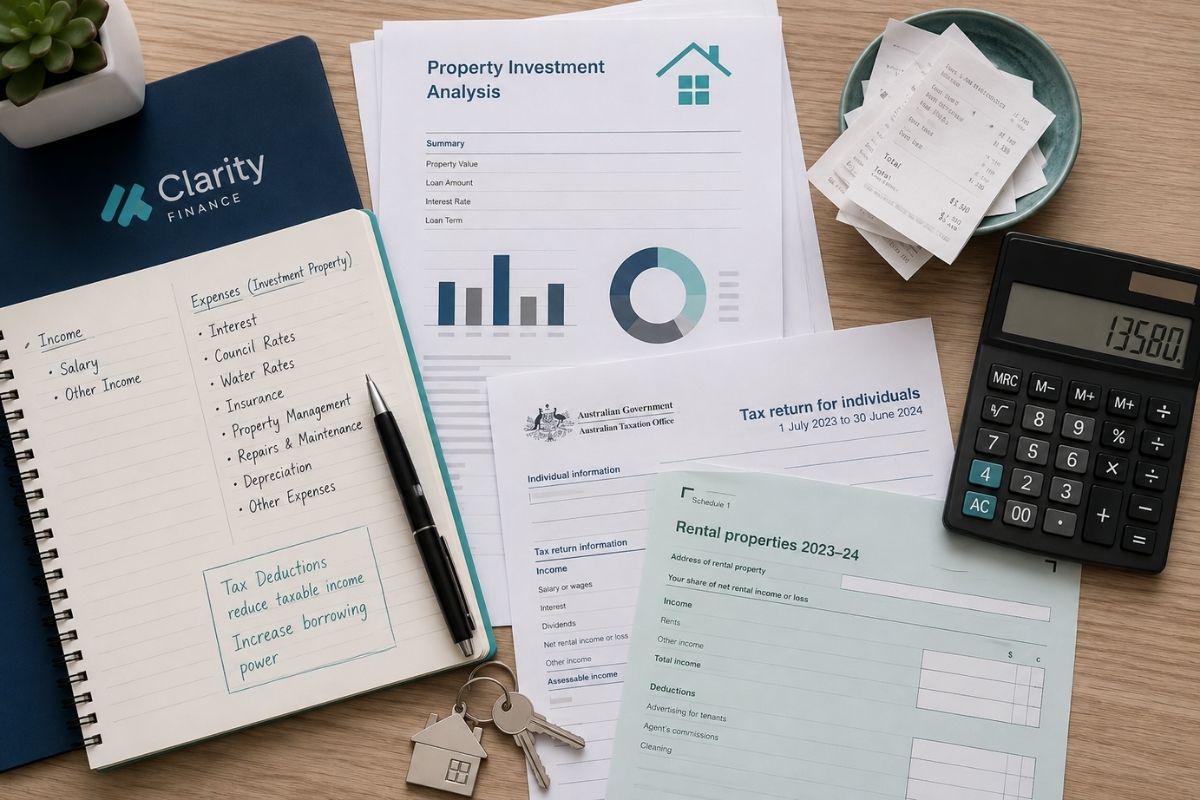
The rental income borrowing power calculation Australia is optimised by selecting the lender with the most favourable combination of rental shading rate, negative gearing add-back policy and overall serviceability model. Clarity Financial Solutions compares these variables across 40+ lenders for every investment application and recommends the lender that produces the highest approved borrowing capacity for your specific portfolio.
For borrowers with multiple investment properties, the cumulative impact of shading policy alone can shift borrowing capacity by over $100,000. Combined with negative gearing add-back and lender-specific living expense calculations, the right lender selection can mean the difference between approval and decline for your next investment property purchase. This analysis is provided at no cost — our fee is paid by the lender on settlement. Explore our rentvesting guide for first-time investors building a portfolio while renting.

Lenders shade rental income by 20% to 30%, counting only 70% to 80% of gross rent in their serviceability assessment. This shading accounts for vacancy, management fees and maintenance. The exact shading percentage varies by lender — and the difference between 70% and 80% can represent $50,000 to $100,000 in borrowing capacity.
Rental income shading is the discount lenders apply to your gross rental income when calculating borrowing capacity. Most Australian banks count 70% to 80% of gross rent — discounting the remaining 20% to 30% to account for vacancy periods, property management fees, rates and maintenance costs.
Yes. Lenders accept estimated rental income for investment properties you are purchasing, supported by a rental appraisal letter from a licensed property manager in the same suburb. The projected rent is then shaded at the lender's standard rate (typically 70% to 80%) before being included in the serviceability calculation.
At lenders that apply a negative gearing add-back, yes. The tax benefit of the rental loss (30% to 37% of the net loss depending on your marginal rate) is added back to your assessable income, improving borrowing capacity by $20,000 to $40,000 per negatively geared property. Not all lenders apply this add-back — Clarity Financial Solutions selects those that do.
For existing rental properties: a current lease agreement or rental statement from your property manager (less than 90 days old). For properties you are purchasing: a rental appraisal letter from a licensed property manager. Your tax return must also declare all rental income — undeclared income cannot be counted by lenders.
Major banks typically shade at 70% to 80% of gross rent. Non-bank and specialist investment lenders may shade at 80% to 90%. The difference between a 70% lender and an 80% lender can represent $50,000 to $100,000 in additional borrowing capacity on the same application. Clarity Financial Solutions selects the lender with the most favourable shading rate for your portfolio.

This article was prepared by Preeti Sidhu, Mortgage Broker at Clarity Financial Solutions (ACL 475676). Information is general in nature and does not constitute financial advice. Always consult a licensed mortgage broker before making any financial decisions.

The rental income borrowing power calculation Australia is optimised by lender selection — not by earning more rent. Clarity Financial Solutions compares shading rates, add-back policies and serviceability models across 40+ lenders to maximise your investment borrowing power at no cost. Explore our interest-only lending guide for investment loan structuring.
WhatsApp us